An in-house aircraft icing code
Dr Mohammad Ghaffari · 2026
Context
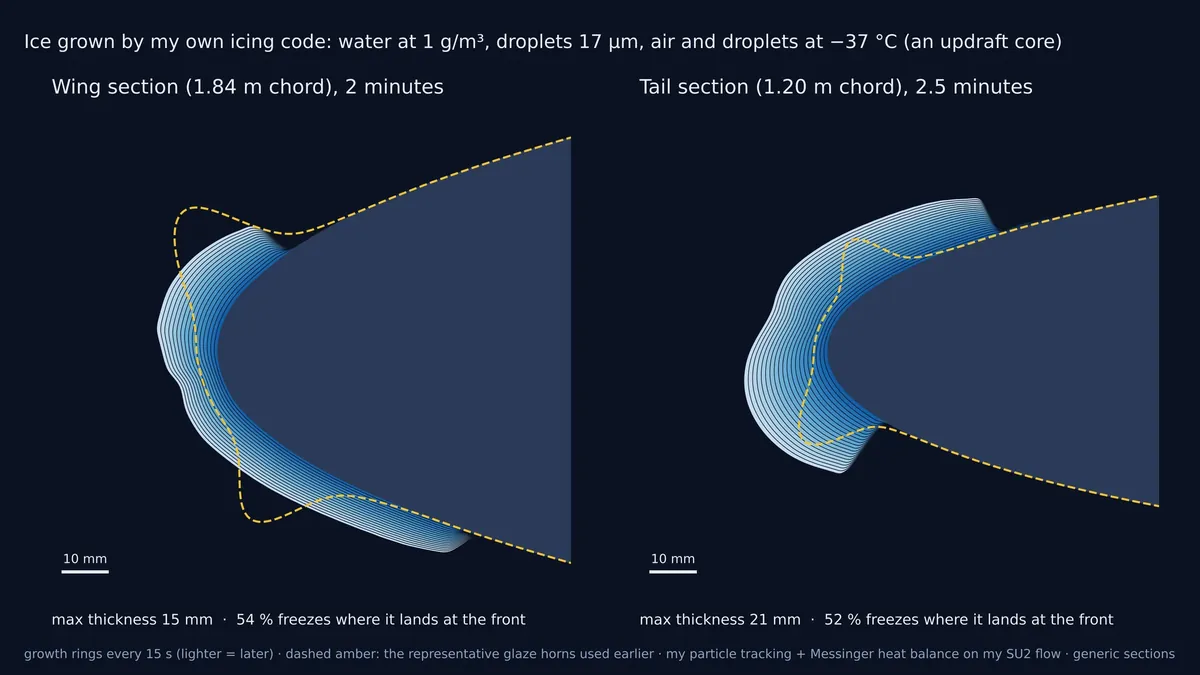
Predicting ice shapes means following cloud particles to the surface, working out how much of the water freezes where it lands, and updating the geometry as the ice grows. I wrote a compact 2D code of this kind on top of SU2 flow fields to study ice accretion in very cold, high-water-content conditions.
Approach
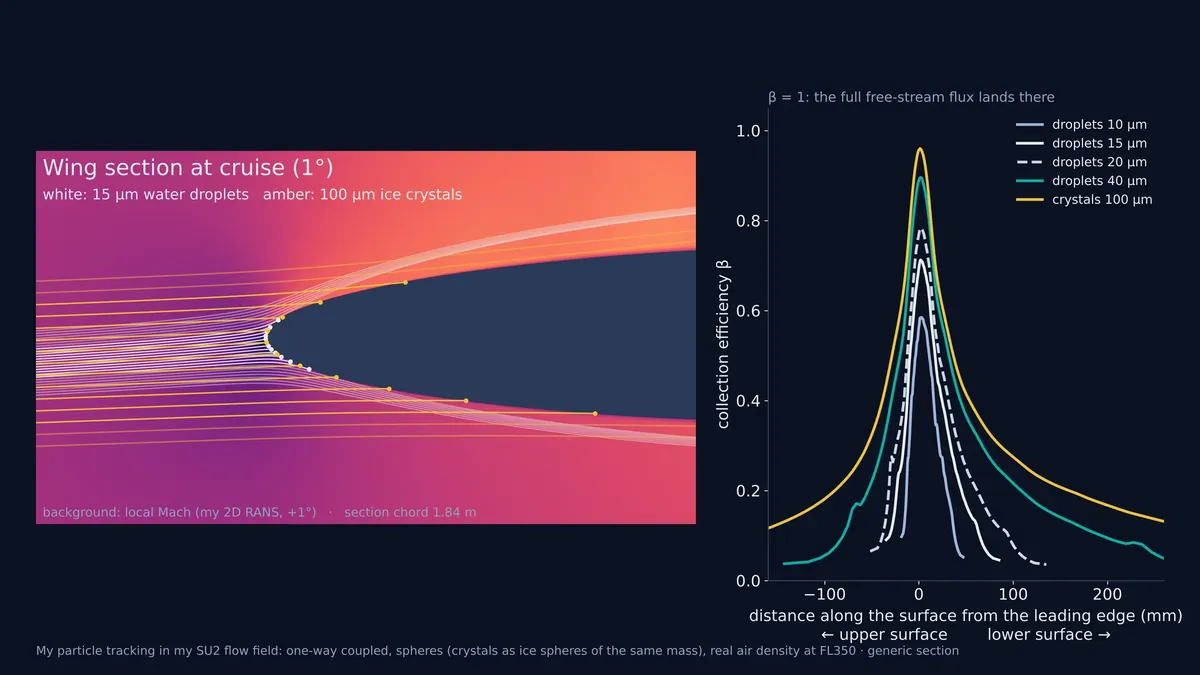
- One-way coupled Lagrangian tracking of 10 to 40 µm droplets and 100 µm ice crystals (as equivalent spheres) with Schiller–Naumann drag in the SU2 fields, scaled to the real chord and air density, giving collection efficiency and impingement limits.
- Heat transfer from Smith–Spalding near the stagnation point and a rough turbulent flat plate downstream, then a Messinger mass and energy balance cell by cell with runback; ice density 917 kg/m³, geometry updated every 7.5 s.
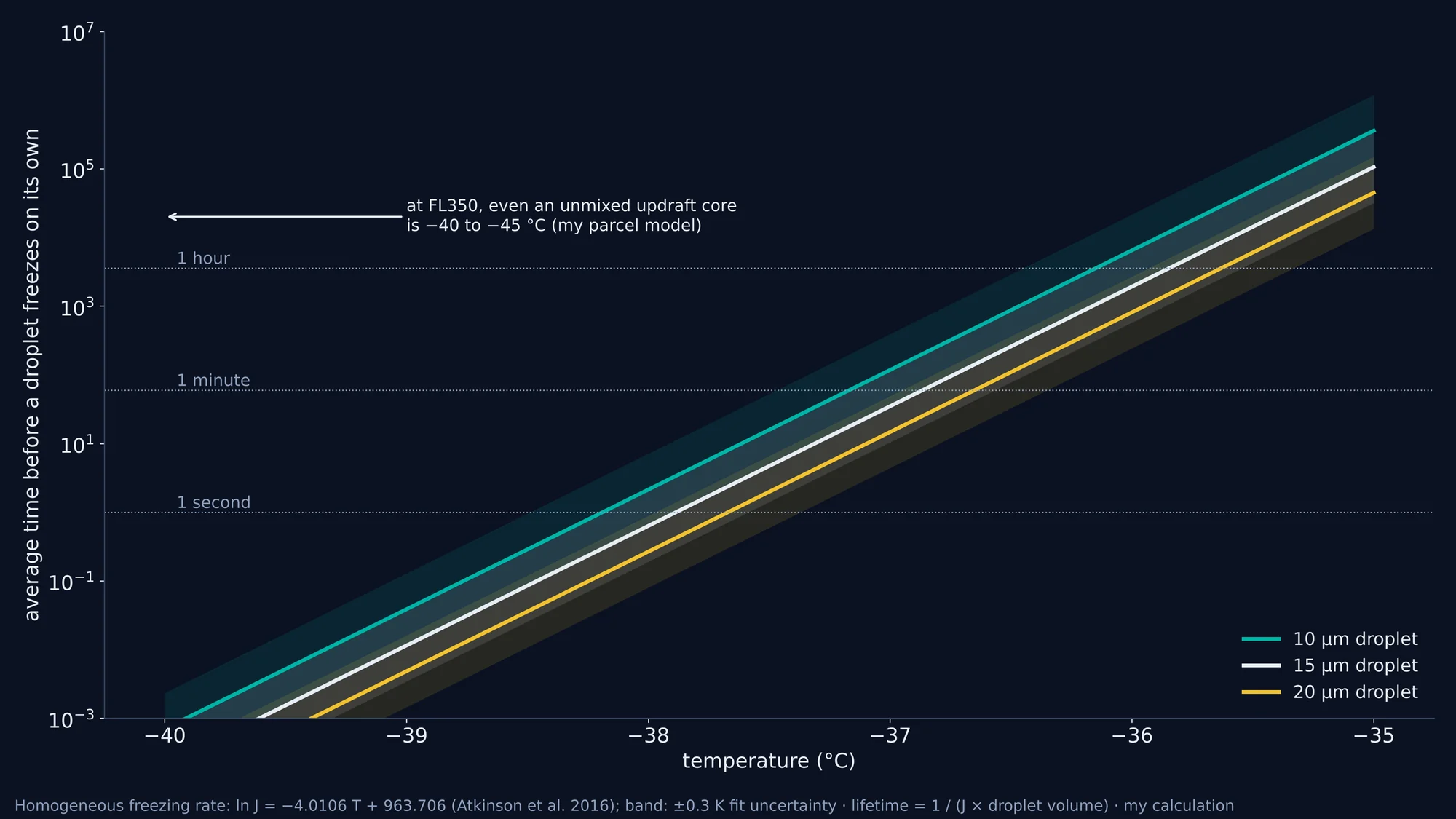
- Homogeneous freezing rates (Atkinson, Murray and O’Sullivan, 2016) to estimate how long supercooled droplets survive; grown shapes re-meshed and run back through SU2.
Figures
Outcome
- Cloud droplets mostly follow the air around the nose (peak collection efficiency 0.59 to 0.78 for 10 to 20 µm droplets on the wing), while 100 µm ice crystals hit almost head-on over a much wider area.
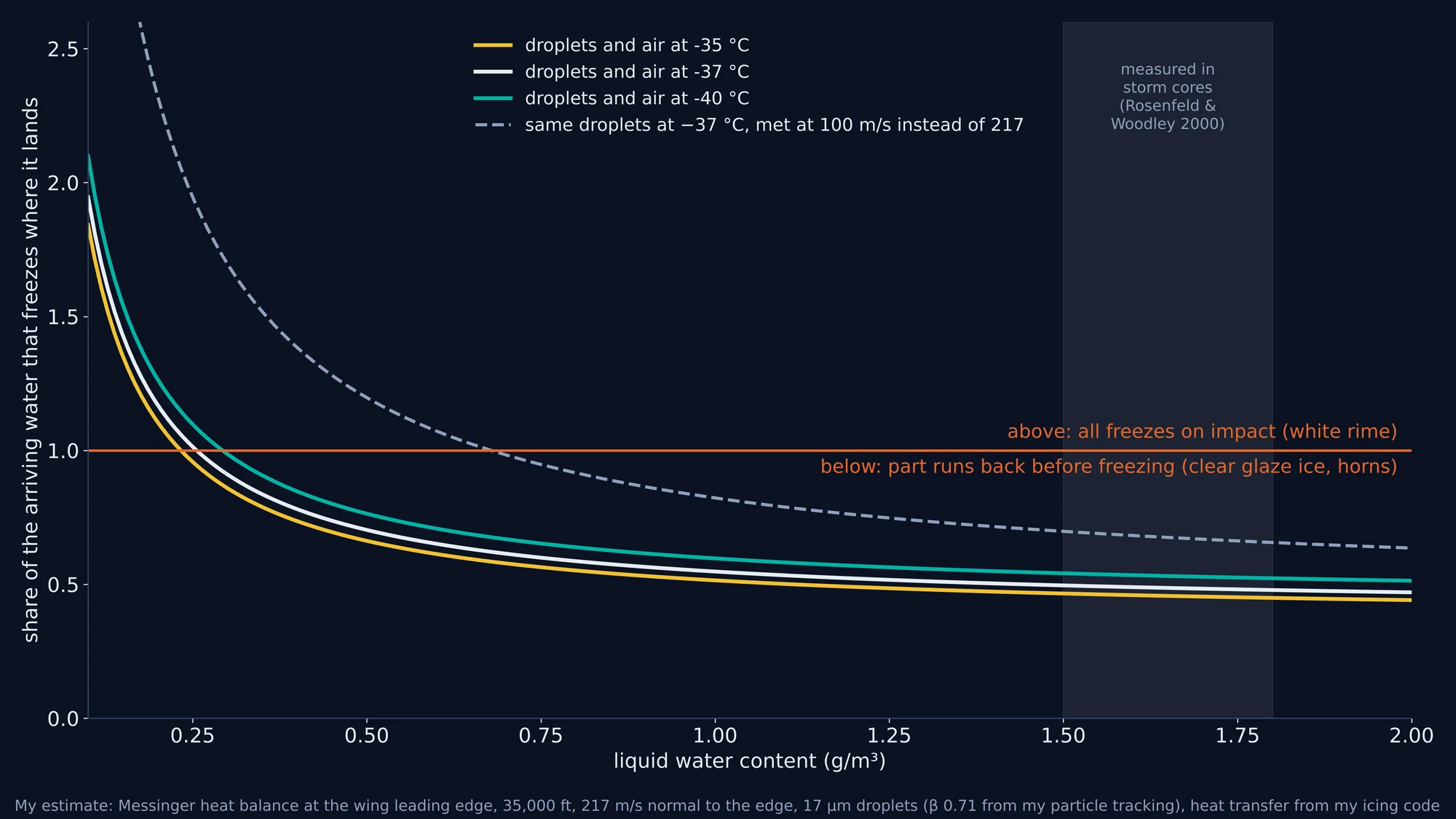
- At −37 °C and 217 m/s, only about half of the water arriving at 1 g/m³ freezes on impact, so even very cold droplets form glaze ice with horns rather than rime.
- The code grows 15 mm of ice on the wing in two minutes and 21 mm, with a double horn, on the tail in two and a half.
- Run back through SU2, the grown wing ice costs 7% of the lift at 2° without bringing buffet forward, while the grown tail ice costs about as much download as the representative horns. The shapes are plausible, not validated against icing-tunnel data.
- Aircraft icing
- Lagrangian particle tracking
- Heat transfer
- Messinger model
- Python
- SU2
Related: Ice on a transonic wing and T-tail