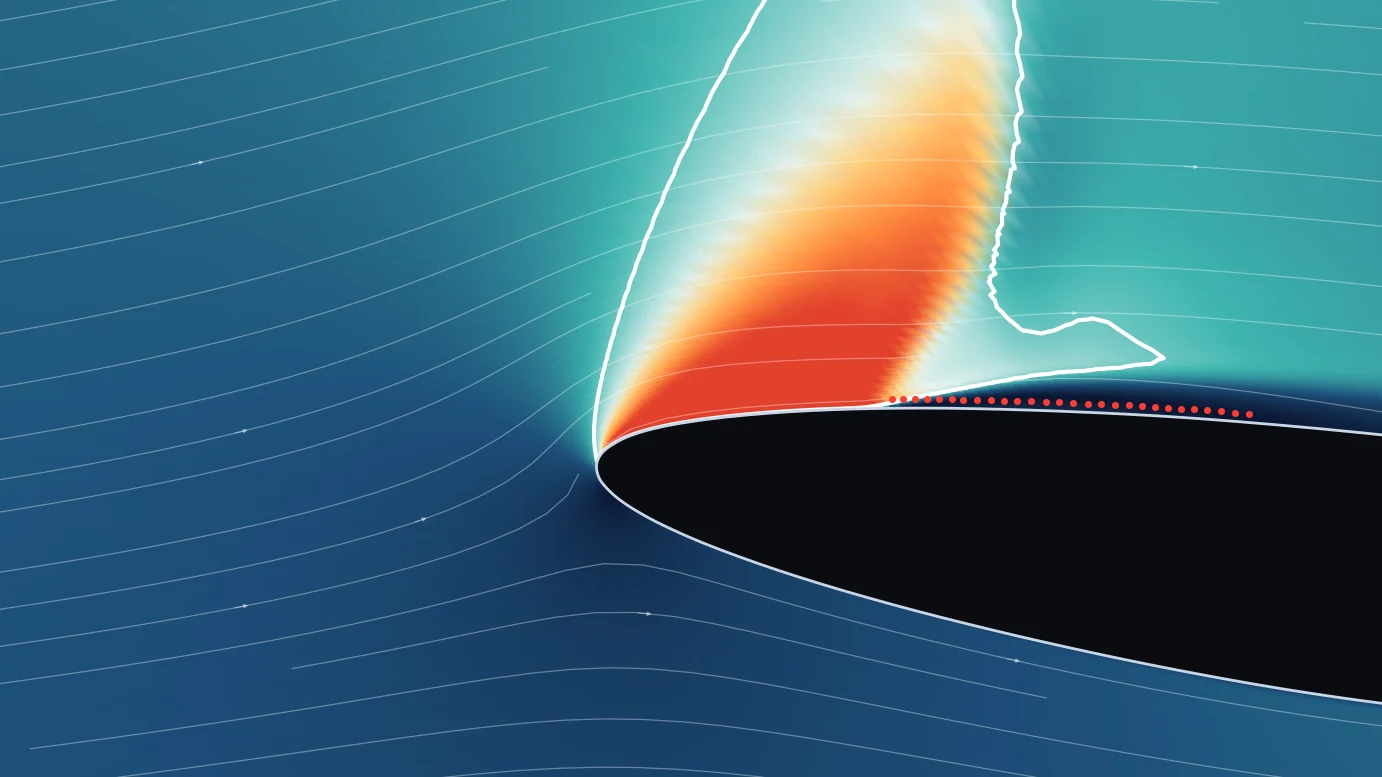
Coffin corner and buffet boundaries of a business jet
Dr Mohammad Ghaffari · 2026
Context
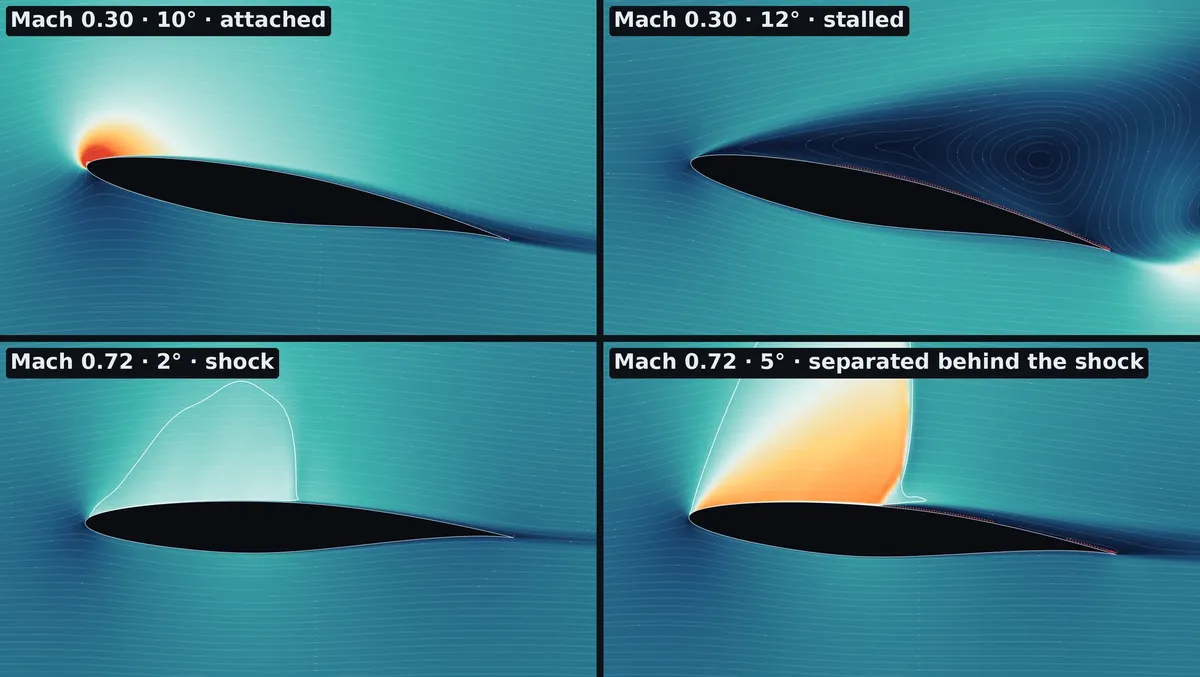
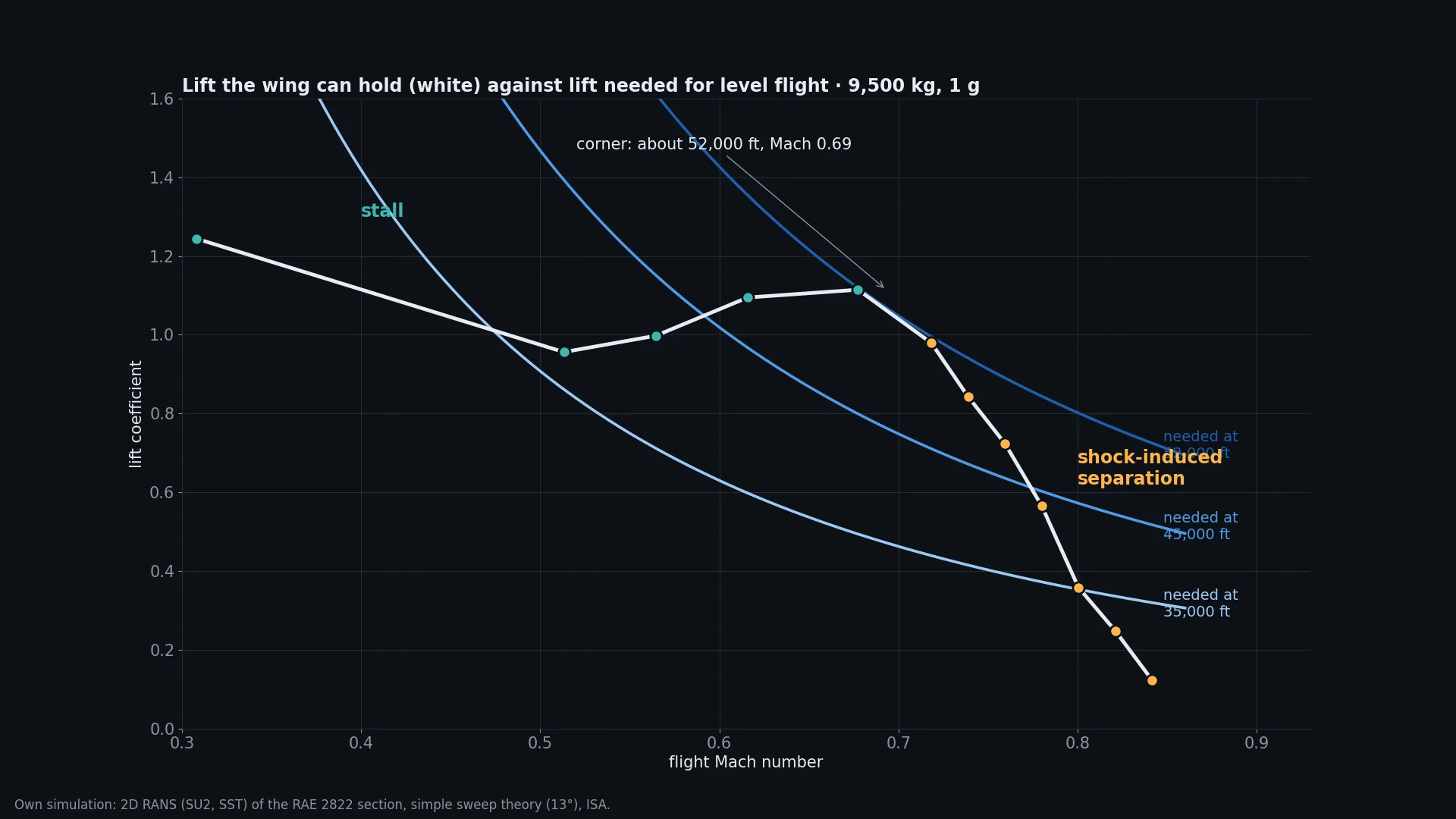
At high altitude a jet's usable speed range closes in from both ends: a low-speed limit set by the stall and a high-speed limit set by shock-induced separation, or Mach buffet. Where the two meet is the aerodynamic ceiling, known as the coffin corner. Published envelopes come from flight testing; this independent study builds one from the flow physics up to show how each edge forms.
Approach
- Ran 98 steady 2D RANS cases (SU2, k-ω SST, Re = 10 million) of the RAE 2822 transonic section at 12 Mach numbers from 0.30 to 0.82, with angle sweeps chained by restart and fine steps near maximum lift. The same grid and solver reproduce the AGARD case 6 lift within about 4.4%.
- Defined buffet onset as reversed flow on the upper surface aft of mid-chord over 5% of the chord; at low Mach number the limit is the last attached run before the stall.
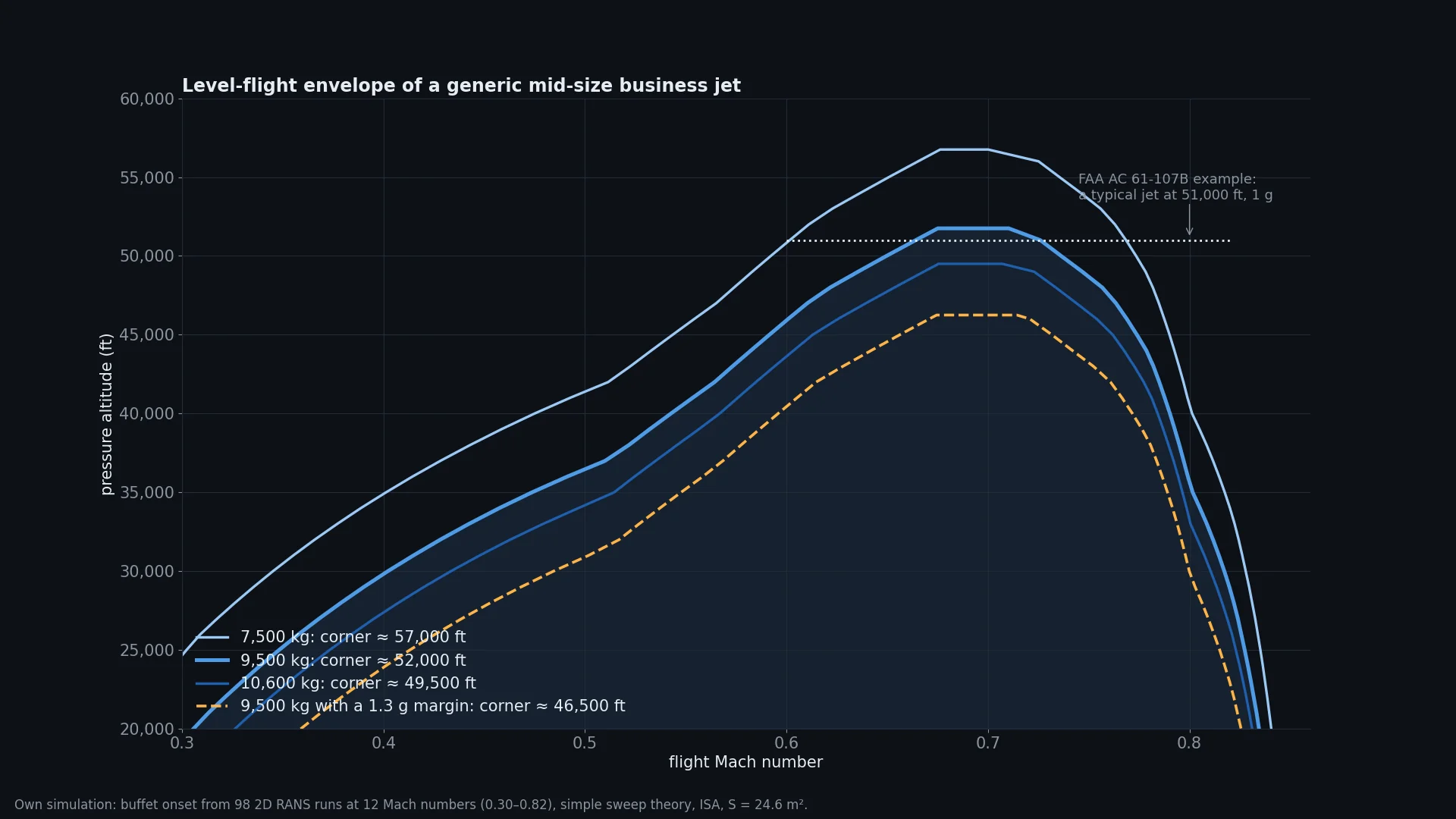
- Converted the section limits to a generic mid-size business jet with simple sweep theory (13°) and solved level flight in the ISA atmosphere for three weights and for a 1.3 g manoeuvre margin.
Figures
Outcome
- At 9,500 kg the generic jet can fly from Mach 0.47 to 0.80 at 35,000 ft, a band of about 190 knots true airspeed, but only from Mach 0.59 to 0.77 at 45,000 ft, about 105 knots.
- The two edges meet at about 52,000 ft near Mach 0.69. A 1.3 g margin brings that ceiling down to about 46,500 ft.
- The section's shock-limited lift falls from 1.03 at Mach 0.70 to 0.38 at Mach 0.78, and above Mach 0.80 the flow behind the shock is separated even at zero angle of attack.
- The section and the sweep correction are generic, so the numbers illustrate the method rather than any real aircraft's limits.
- RANS
- Transonic buffet
- Coffin corner
- Flight envelope
- SU2
Related: Ice on a transonic wing and T-tail