Mach 0.88 with 4° of elevator: the shock sits on the hinge line and the flow behind it separates. The loop shows the section pitching 4 ± 2° in unsteady RANS. Own simulation.
Elevator effectiveness and hinge moments in transonic flow
Dr Mohammad Ghaffari · 2026
Context
At high subsonic Mach numbers the shock on a tail surface moves aft toward the elevator hinge. Once it sits on the hinge and the flow behind it separates, deflecting the elevator changes less of the pressure field, and the hinge moment needed for a given tail load rises. This independent study quantifies both effects on a generic tail section.
Approach
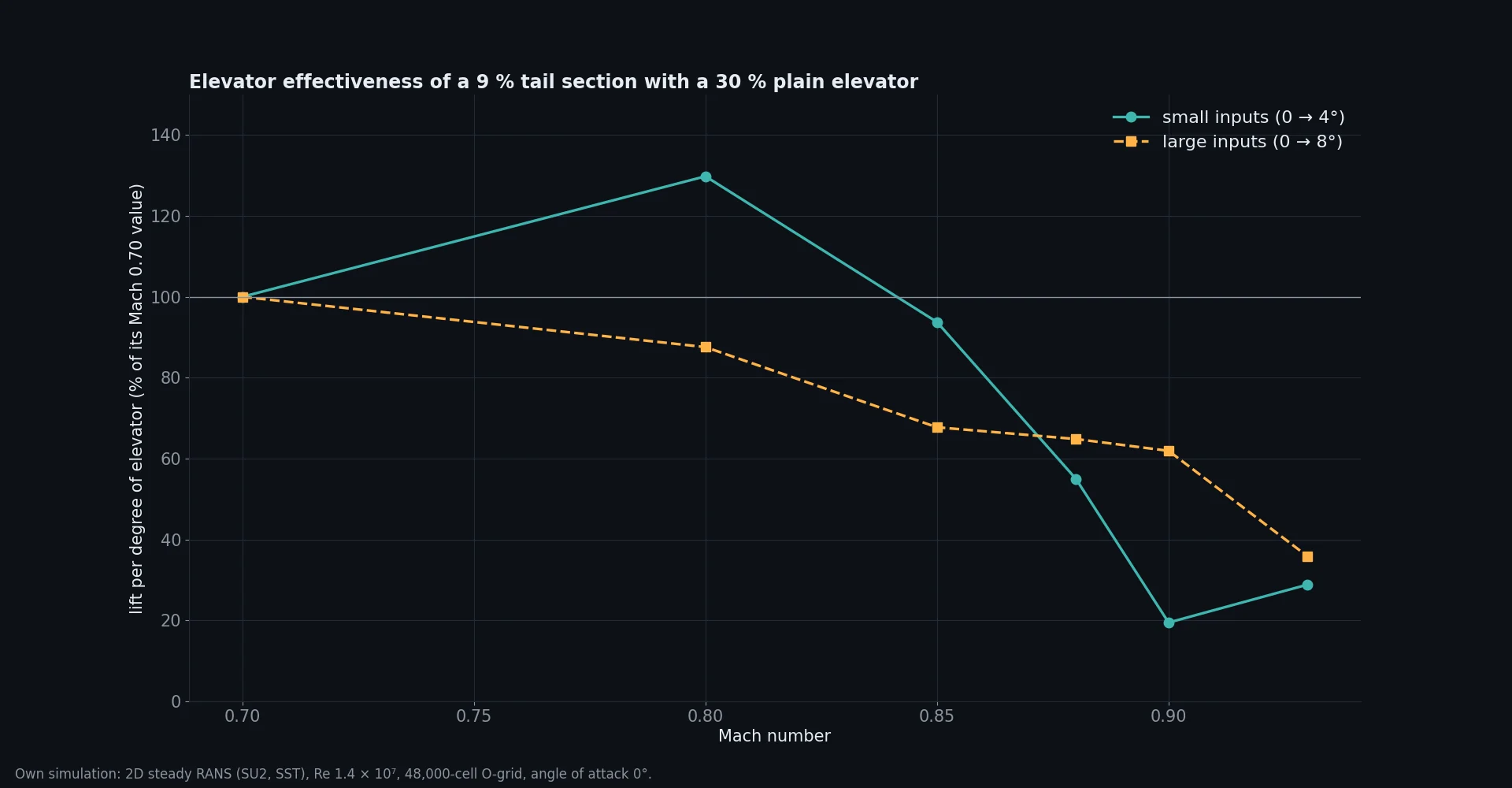
- Generic 9% symmetric tail section with a 30% plain elevator (hinge at 70% of the chord) at 0°, 4° and 8° of deflection; O-grids of 48,000 cells with y+ below 1; SU2 steady RANS with SST at Re = 1.4 × 10⁷ from Mach 0.70 to 0.93.
- Checked the trend on a four-times finer grid, ran lift and buffet sweeps of the tail section from 2° to 10°, and integrated hinge moments about the hinge line.
- Pitched the section 4 ± 2° in dual-time unsteady RANS at reduced frequencies of 0.023 and 0.10 to test whether steady values hold for slow manoeuvres.
Figures
Outcome
- Between Mach 0.80 and 0.90 the first 4° of elevator lose about 85% of their lift per degree; larger inputs keep about two-thirds. The finer grid confirms the trend: by about Mach 0.9 the elevator makes about a third of its normal lift or less.
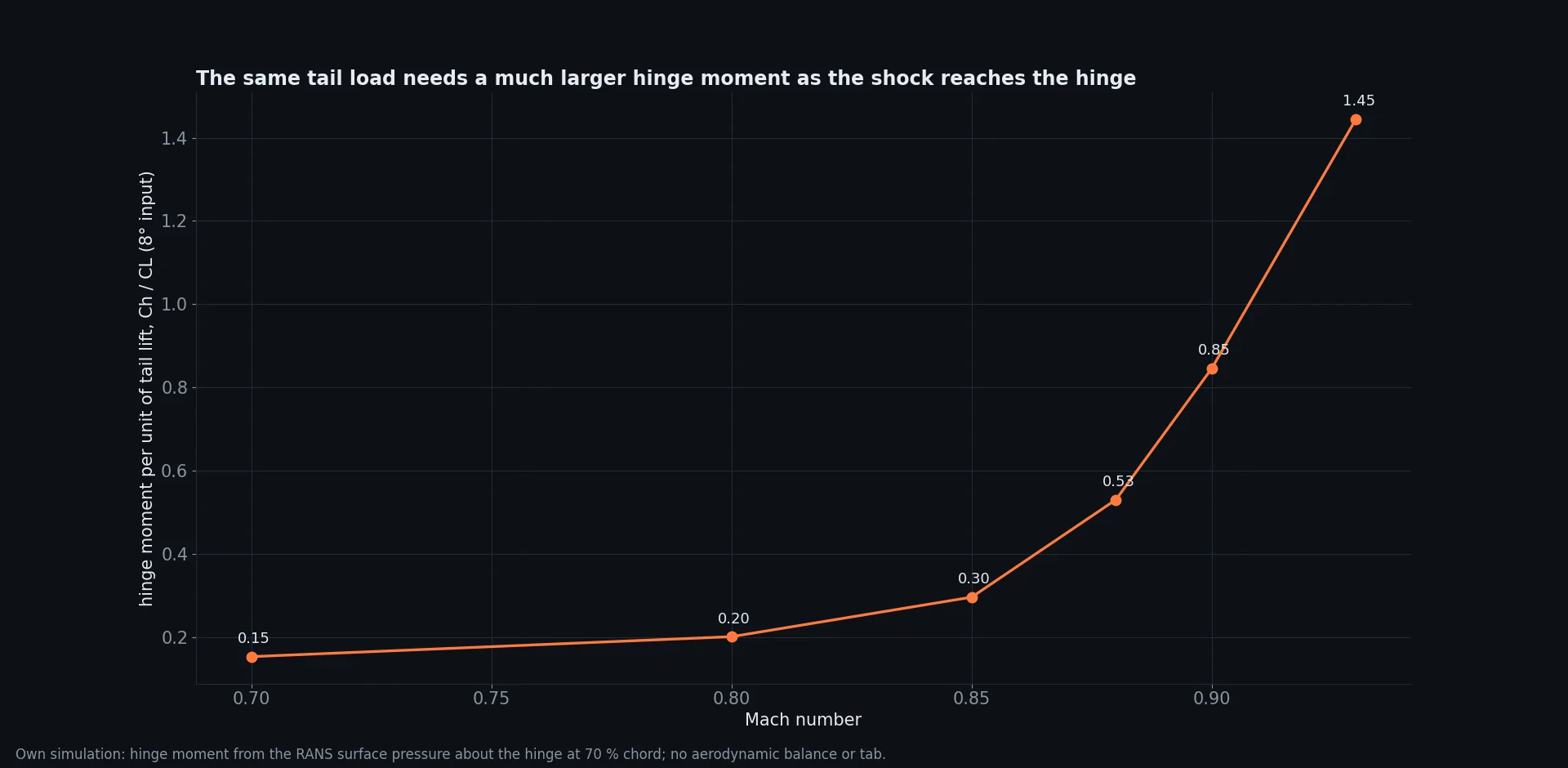
- The hinge moment per unit of tail lift grows from 0.16 at Mach 0.70 to 0.87 at Mach 0.90 and 1.45 at Mach 0.93, so a manually controlled elevator would need several times the stick force per g.
- At pull-out rates the unsteady loops sit on the steady values; faster motions show lag and overshoot.
- RANS
- Unsteady RANS
- Control surfaces
- Hinge moments
- SU2